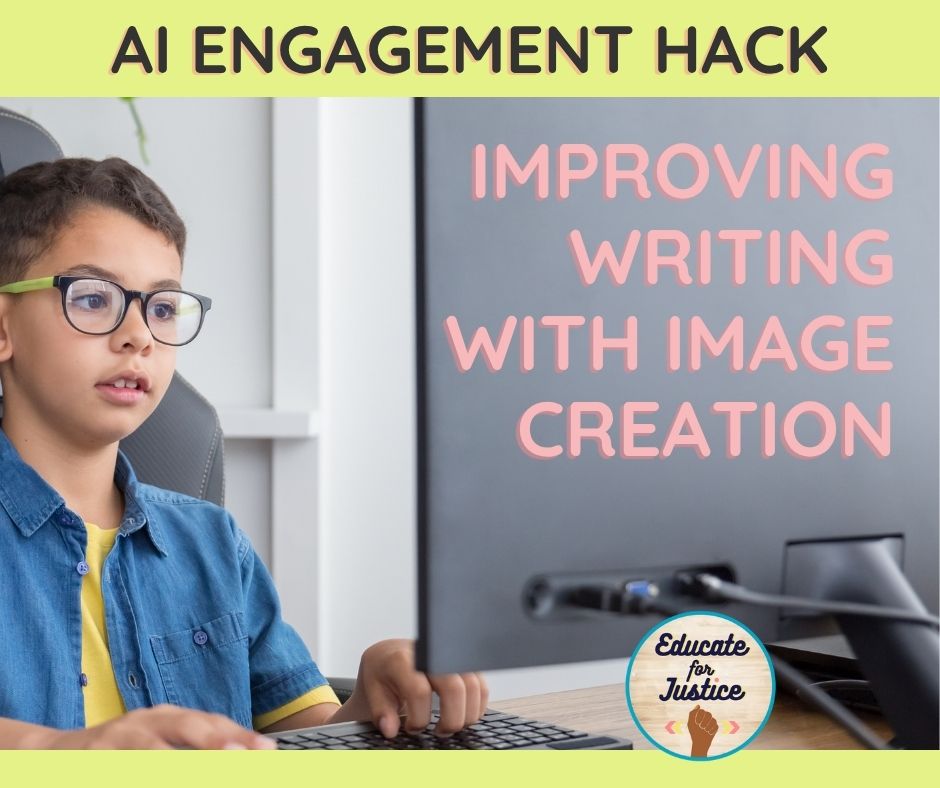
If you’ve been trying to find new ways to keep students engaged while still hitting those literacy standards, you’re not alone. I’ve been experimenting with AI image generators for the classroom and I’m excited for the possibilities. Not just because it’s fun (and trust me, it is), but because it’s standards-aligned, builds essential AI literacy, and pushes students to write with clarity and precision.
It’s engaging, standards-aligned, and honestly, a small shift that can make a big impact.
A quick nod to the standards: this work lines up with Common Core writing standards about using concrete, descriptive language (like W.3.D, W.9-12.3.D) and speaking and listening standards when students collaborate and reflect (SL.1, SL.4). And if you’ve got younger students, you can scale this down to match W.K-3.2 and W.K-3.3 — it’s that adaptable.
And beyond the standards, we can’t ignore how important it is for our students to develop AI literacy. One presenter at ISTE this year described this activity as “painting with language” — and I loved that. It’s exactly what we’re doing: helping students understand how language choices shape outcomes, and giving them a hands-on way to see that in action.
How I Use AI Image Tools for Precision and Classroom Engagement
Here’s how I implement this in a way that’s flexible, easy to adapt, and doesn’t eat up your whole period. You don’t have to do every step every day — it actually works better to mix it up and keep students on their toes.
Pro tip: I use TwinPics AI for this because it’s free, gives a score for prompt accuracy, and limits to one use per device per day — which means students have to plan ahead and think strategically before submitting.
Step 0: Prompt Planning
Before we even touch the tech, it helps to talk through what makes a good prompt. Ask students:
- What subjects should appear in the image?
- What descriptive words would help shape how those things look?
- What action or setting should the image include?
This alone gets students thinking about language purposefully — and you can almost see the light bulbs turn on.
Step 1: Cocreate a Prompt
As a class, build a prompt together. Everyone can throw out ideas for key descriptive words, and we can talk about what’s essential, what’s fluff, and how order or specificity might matter.
I always write the prompt on the board before we type it into TwinPics. It helps us refer back to it when we reflect later.
Step 2: Reflect on the Results
Once the image generates, we don’t just look at the score. We have a quick discussion:
- What worked?
- What seemed to get ignored?
- Which words probably triggered the AI to make certain choices?
It’s metacognition in disguise.
Step 3: Revise in Groups
Then, in table groups or partners, students revise the prompt to improve it. They debate which words to keep, which to swap out, and what might clarify things for a better image match.
This is where the real collaboration and precision work happen. And bonus: students forget they’re practicing descriptive writing because they’re too busy trying to beat each other’s scores.
Step 4: Friendly Competition
Once the new images and scores come in, we have a quick check-in: who made the biggest improvement? More importantly, what did they change that made the difference?
I love how naturally this encourages students to reflect on word choice and clarity — it feels authentic because the stakes feel real (even though it’s just a score on a screen).
Step 5: Share and Celebrate
One of my favorite parts is letting students see one another’s images and prompts.
You can do this with:
- A gallery walk with printed images
- Projecting screens one by one
- Using a tool like GoGuardian to display student screens on the board
Seeing different strategies play out in real time gives students ideas for next time, and builds confidence when they realize how far they’ve come.
Why It Works
You don’t need to do all five steps every day. In fact, switching up the routine keeps it fresh. But what I’ve noticed is that students start taking real pride in improving a specific, measurable skill — and that confidence carries over to their essays, narratives, and responses to literature.
Even better, it unlocks metacognitive habits. Students begin asking themselves “what word might work better here?”in other assignments too, and those little moments of reflection are what build truly independent writers.
AI isn’t going anywhere. But if we use it thoughtfully — not just as a shiny toy, but as a tool to build precise, collaborative, reflective writers — we’ll be setting our students up for success both in and beyond our classrooms.