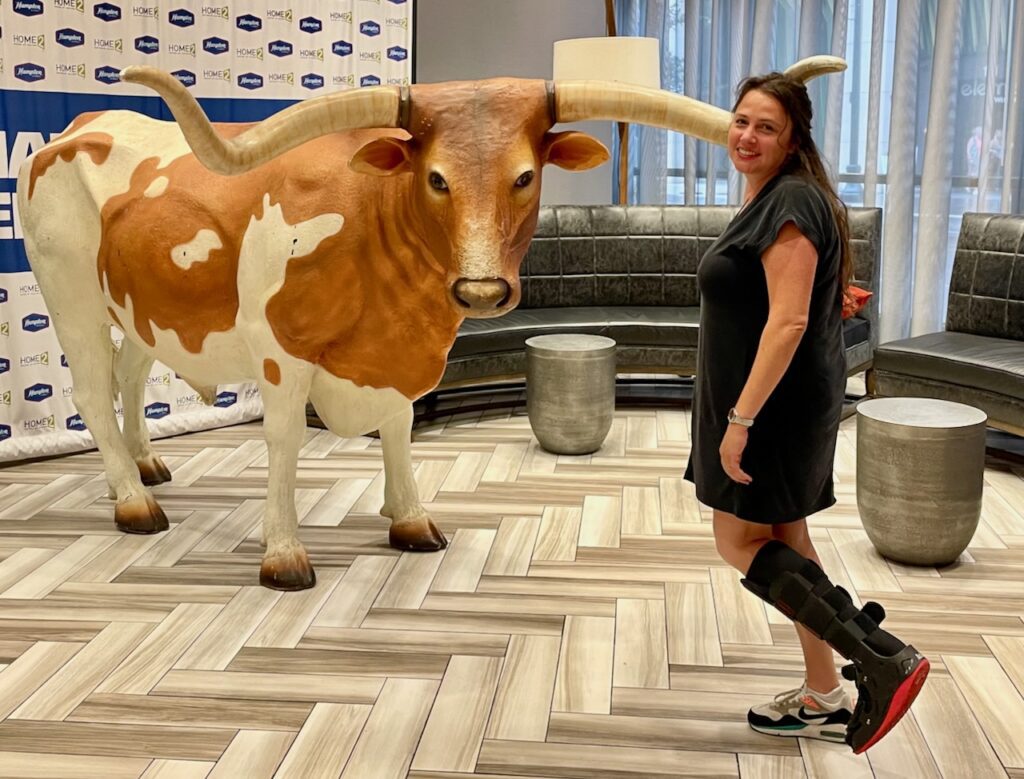
Earlier this month I was in San Antonio for ISTE+ACSD 2025. This is the first time the two conferences were combined, and to be honest, that’s really what I’m most excited about. I think AI has the potential to be a great arbitrator of equity in our school systems. Of course, it also has the potential to be one more gap in the digital divide if we don’t steer that course as classroom teachers. That’s why it feels so urgent that we get clear on what we want AI to look like in our classrooms before someone else decides that for us.
I got a lot out of the conference—new ideas, fun swag, new connections—but the most valuable thing was a chance for me to reframe my thoughts on AI in schools. I went in cautiously curious and left feeling like there’s space for thoughtful, intentional use that centers students, especially those our systems haven’t historically served well.
I’ve come to a few key conclusions that leave me cautiously optimistic and a little excited:
The train has left the station.
AI is already in our students’ hands, whether we’ve officially welcomed it into our classrooms or not. Pretending it isn’t there or banning it outright won’t stop its use—it’ll just push it underground where it’s less guided and potentially inequitable. I’m realizing we have a real opportunity to teach responsible, critical use if we’re brave enough to have those conversations out loud.
AI literacy for students may be more important than for teachers.
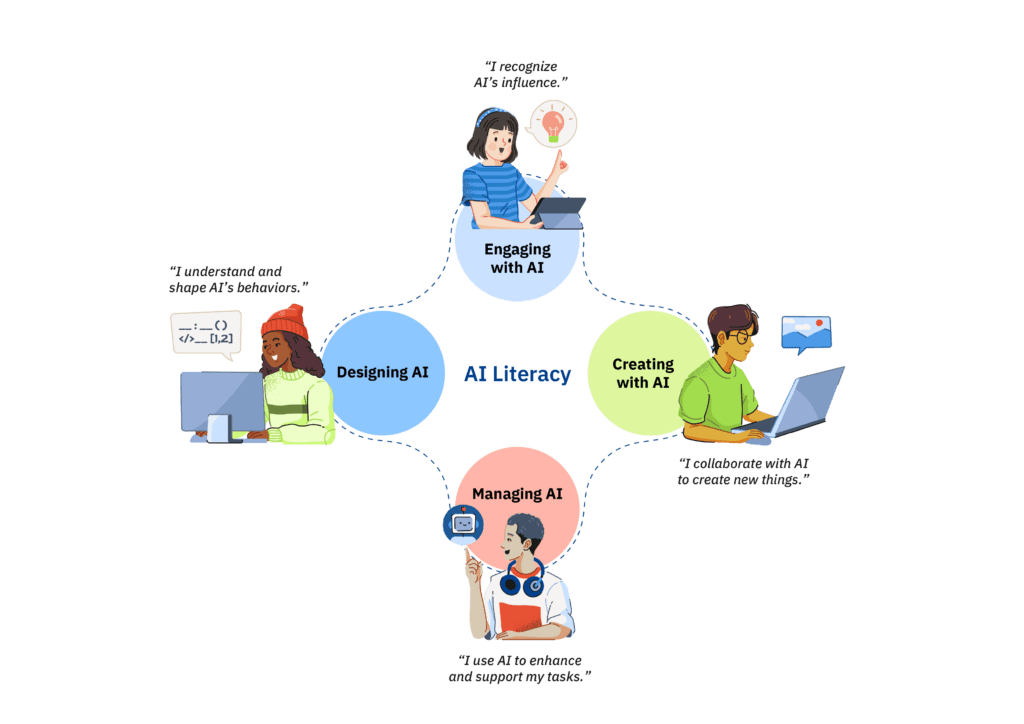
While it’s valuable for teachers to understand AI tools, it’s essential that our students do. They’re the ones who will navigate careers, higher education, and civic life shaped by AI far beyond what we can imagine right now. I’m thinking more about how to build their skills to ask good questions, vet sources, and recognize when a tool is working for them—or against them. My thinking on this is really being assisted by looking at the “Four Domains of AI Literacy” from TeachAI.
The research is starting to offer a game plan for AI in the classroom.
A new MIT study shows that students who START their projects with AI drafts have less ownership and cognitive growth from their writing projects even if they come back to edit on their own. On the other side, increasing case studies are showing that students who get real-time feedback from tools like chatbots are growing their writing faster just because they can get more immediate feedback than any teacher with a classroom full of writers can offer. We have to find the balance for students to start with their own ideas and refine with AI feedback. For students who have more space to regain from past learning loss, this could be a game changer.
AI literacy doesn’t have to be separate from literacy.
The good news? We don’t have to invent entirely new frameworks. Teaching students to analyze bias, recognize credible information, and question how a text was created? That’s literacy. So is prompt engineering. Visual tools like twinpic.ai and Google Experiments’ “Say What You See” require students to use the same precise, rich language we ask them to improve in their writing. makes this work feel a little less intimidating to fold into what I’m already doing.
Chat agents, and their use, will determine if AI widens or lessens the digital divide.
Chat agents are showing up widely as “tutors”and guides. It was interesting to hear how Knowt, a free tool, saw a huge shift in enrollments right before AP tests last year. So I know some of my students are going to get there. If only well-resourced students and families have the guidance to teach responsible AI use, the gap just grows. But if we as classroom teachers model transparent, ethical, and inclusive AI practices, we can help level that playing field. Picking the right chat agent(s) to introduce my students to, and even building some of my own has become top of the list for my planning for the coming year.
The guardrails and accuracy still have space to go.
I’m not naive about the limitations—misinformation, bias baked into data sets, and uneven accuracy still make me wary. I am still getting responses from chat bots that reflect the historical biases that it pulls from on the internet, but those aren’t the only remaining gaps.
I was disappointed to hear someone demo’ing a grading tool admit that they’d seen differences of up to ten points in how the same sample assignment was graded with their tool. That level of variance doesn’t seem fair to my students. AI grading also can’t give credit for growth in the way a teacher can yet. But it also reminds me that we can teach students to spot those issues, just like we do with traditional texts. AI isn’t perfect, but neither are people, and that’s exactly why we need critical thinkers in the driver’s seat.
I’m still thinking a lot about how my classroom and teaching will be different in the coming school year with integration of AI and what I’ll keep exactly as it’s been. I’m excited for the journey.